Concrete Footing Calculator
Choose a rectangular footing or a round footing, such as a post hole or tube form, and enter its dimensions to estimate the concrete in cubic feet and cubic yards. Optional bag counts use published QUIKRETE yields.
Free calculator • US customary units • Clear formulas • Last reviewed October 2026
Calculate with the footing calculator
Enter your measurements and press Calculate. Results appear beside the form on wide screens and below it on phones.
Quick answer: for a round footing, volume = π × (diameter ÷ 2)² × depth. A 12 in diameter hole that is 36 in deep holds about 2.36 cubic feet, or roughly 4 bags of 80 lb mix at QUIKRETE’s published yield before any waste allowance.
How the footing calculation works
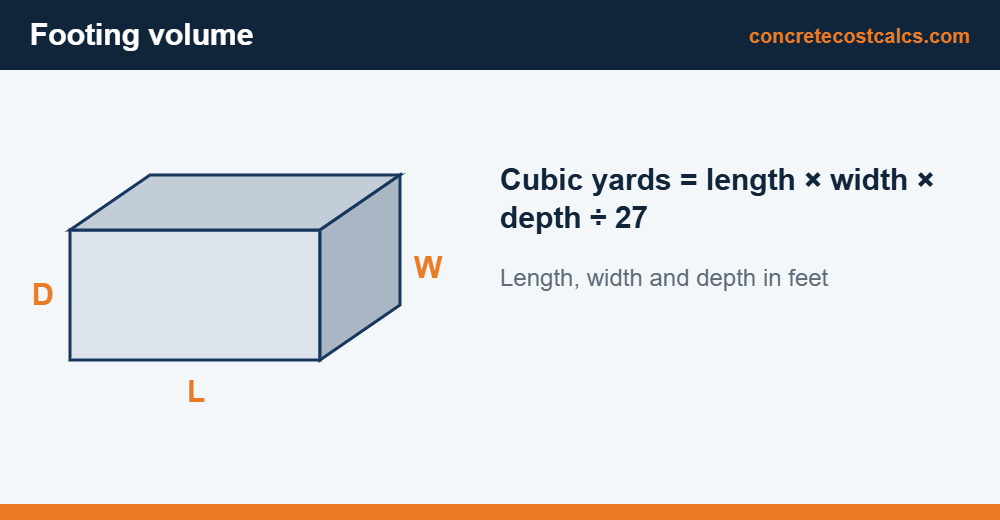
A rectangular footing is a box, so its volume is length × width × depth. A round footing, such as a post hole or tube form, is a cylinder, so its volume is π times the radius squared times the depth. Dimensions are converted to feet first, then cubic feet are divided by 27 for cubic yards.
Rectangular cubic feet = length (ft) × width (in) ÷ 12 × depth (in) ÷ 12
Round cubic feet = π × (diameter in ÷ 24)² × depth (in) ÷ 12
Cubic yards = cubic feet ÷ 27, multiplied by the number of footings and your waste allowance
Worked examples
| Footing | Cubic feet | Cubic yards | 80 lb bags (0.60 cu ft each), no waste |
|---|---|---|---|
| Round, 12 in diameter, 36 in deep | 2.36 | 0.087 | 3.93, so 4 bags |
| Rectangular, 20 ft × 16 in × 12 in | 26.67 | 0.99 | 44.44, so 45 bags |
Bag counts use the QUIKRETE Concrete Mix No. 1101 published yield of approximately 0.60 cubic feet for an 80 lb bag.
Deck footings
Deck footings are sized from the load they carry, so there is no single diameter that fits every deck. The load on one footing is the deck area it supports (its tributary area) multiplied by the total load per square foot. Decks.com (a Trex Company site, article dated 9/18/2024) lists a minimum dead load of 10 psf and a minimum live load of 40 psf, and says to use the higher of dead plus live or dead plus snow. In its example, a footing that supports 25 square feet in central Minnesota (50 psf snow, 60 psf total) carries 1,500 lb, and the footing diameter works out to a minimum of 19, 16 or 14 inches depending on the soil.
The same page lists these soil bearing pressures for undisturbed, compacted soil:
| Soil type (as listed by Decks.com) | Bearing pressure (psf) |
|---|---|
| Clay, silty clay, clayey silt, silt, sandy silt clay | 1,500 |
| Sandy or silty sand, clayey sand, silty or clayey gravel | 2,000 |
| Sandy gravel and/or gravel | 3,000 |
| Sedimentary and foliated rock | 4,000 |
| Crystalline bedrock | 12,000 |
Decks.com attributes its chart to Table R507.3.1 of the 2021 IRC. This site did not read that table directly, so confirm the diameter with your local building department. On depth, the same page says most codes require footings at least 12 inches deep, and that colder states such as Minnesota can require 4 feet or more.
Concrete for one round footing. As a calculation example only (the 16 inch diameter and 42 inch depth are example inputs, not code values): a 16 inch round footing 42 inches deep is about 4.89 cubic feet, or 0.18 cubic yards, which is 9 bags of 80 lb mix at 0.60 cubic feet per bag. Enter your own diameter and depth in the calculator above.
House footings
Depth. Jaspector, which paraphrases IRC 2021 section R403.1.4 (page reviewed 2026-04-11), says exterior footings must be at least 12 inches below undisturbed ground, and that frost protection under R403.1.4.1 can require them to go deeper, below the local frost depth. Your local building department sets the frost depth.
Width and thickness. A SAFEbuilt handout hosted by the City of Mound, Minnesota (copyright 2020, based on the Minnesota State Building Code) reproduces IRC Table R403.1(1) for light-frame construction at 50 psf snow or roof live load. Sizes are width by thickness in inches, by soil bearing pressure:
| House type | 1,500 psf | 2,000 psf | 2,500 psf | 3,000 psf |
|---|---|---|---|---|
| 1 story, slab or crawl space | 12 x 6 | 12 x 6 | 12 x 6 | 12 x 6 |
| 1 story with basement | 21 x 6 | 16 x 6 | 13 x 6 | 12 x 6 |
| 2 story, crawl space | 19 x 6 | 14 x 6 | 12 x 6 | 12 x 6 |
| 2 story with basement | 25 x 7 | 19 x 6 | 15 x 6 | 12 x 6 |
The handout says the table is based on a 32 foot wide house, and that for every 2 feet of change in house width you add or subtract 2 inches of footing width and 1 inch of thickness. Footing thickness is not less than 6 inches. The handout does not name an IRC edition and is written for Minnesota, so these values may differ from your local code. Treat them as an example, not a design.
Concrete for a continuous footing. Calculated from the sizes above: 100 linear feet of a 12 x 6 inch footing is 50 cubic feet, or 1.85 cubic yards (about 84 bags of 80 lb). The same run of a 19 x 6 inch footing is 79.17 cubic feet, or 2.93 cubic yards (about 132 bags).
Assumptions and limits
- The tool assumes the footing is filled completely to the dimensions you enter. A tube form with a flared base or a hole wider than the form needs extra concrete.
- It does not tell you what size or depth a footing must be. Footing size and depth depend on the structure, soil, frost conditions and local building code. Check with your local building department or a qualified professional.
- It does not subtract the volume of posts or reinforcing steel.
- Bag counts depend on the yield of the product you buy. The QUIKRETE figures apply to Concrete Mix No. 1101 only.
This is an informational estimate, not engineering or construction advice. See the disclaimer and how the calculations work.
Sources
- Bag yield: QUIKRETE Concrete Mix No. 1101 data sheet, revised October 2022 (approximately 0.30, 0.375, 0.45 and 0.60 cubic feet for 40, 50, 60 and 80 lb bags). Read October 2026.
- Deck footings: Decks.com deck footing size chart, dated 9/18/2024. Read November 2026.
- Footing depth: Jaspector, IRC 2021 R403.1.4, reviewed 2026-04-11. Read November 2026.
- House footing sizes: SAFEbuilt footings handout on the City of Mound site (copyright 2020). Read November 2026.
- Volume: standard geometry (rectangular prism and cylinder) and 1 cubic yard = 27 cubic feet.
Content last reviewed October 2026. No engineering, contractor or other professional credentials are claimed; see the About page.
Frequently asked questions
How do you calculate concrete for a round footing or post hole?
Cubic feet = π × (diameter in inches ÷ 24)² × depth in inches ÷ 12. For a 12 in diameter, 36 in deep hole, that is about 2.36 cubic feet.
How many bags of concrete do I need for a 12 inch by 36 inch post hole?
About 3.93 bags of 80 lb mix, so 4 bags, before any waste allowance, using QUIKRETE’s published approximate yield of 0.60 cubic feet per bag. With a 10% allowance the estimate is 5 bags.
How do you calculate concrete for a rectangular footing?
Multiply length in feet by width in feet by depth in feet. If width and depth are in inches, divide each by 12. Divide the cubic feet by 27 for cubic yards.
How deep and wide must my footing be?
That is set by the structure, soil, frost conditions and local building code, not by this calculator. Ask your local building department or a qualified professional.
Does the calculator subtract the post?
No. It assumes the full footing is filled with concrete, which keeps the estimate on the safe side for ordering.
Related calculators and guides
- Sonotube concrete calculator: round tubes and circular pads
- Rebar calculator: bars, feet and weight for a slab grid
- Monolithic slab calculator: slab with a thickened edge
- Concrete slab calculator: Cubic yards and cubic feet for a rectangular slab
- Concrete bag calculator: Number of 40, 50, 60 or 80 lb bags
- Gravel calculator: Cubic yards of gravel, and tons from your own density
- Main concrete calculator: volume, bags and material cost for a slab
- How many bags of concrete per fence post: bag counts for 4×4 and 6×6 posts
- How the calculations work: formulas and assumptions
Building a block wall on the footing? Count the blocks with the concrete block calculator.