Gravel Calculator
Enter the length, width and depth of the area to estimate how much gravel you need in cubic yards and cubic feet. To convert to tons, enter the density your supplier quotes. The calculator does not assume one.
Free calculator • US customary units • Clear formulas • Last reviewed October 2026
Calculate with the gravel calculator
Enter your measurements and press Calculate. Results appear beside the form on wide screens and below it on phones.
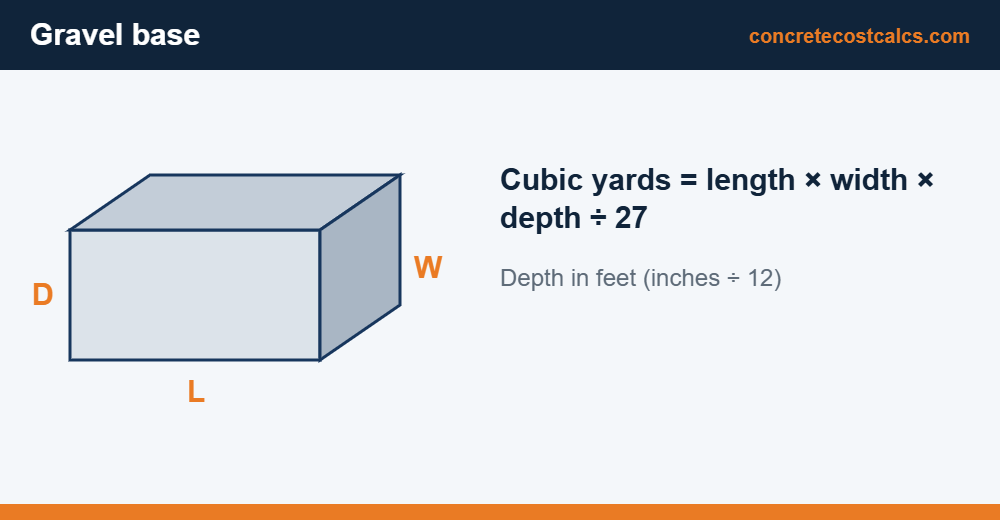
Quick answer: multiply length (ft) × width (ft) × depth (in) ÷ 12 for cubic feet, then divide by 27 for cubic yards. To get tons you also need the weight of your specific gravel, which varies by material, so use your supplier’s figure.
How the gravel calculation works
Gravel is spread in a layer, so its volume is the area multiplied by the depth. Suppliers usually sell gravel by the cubic yard or by the ton. Volume comes straight from geometry, but weight depends on the density of the stone, and that varies by material, size and moisture. That is why this tool only gives tons after you supply a density.
Cubic feet = length (ft) × width (ft) × depth (in) ÷ 12
Cubic yards = cubic feet ÷ 27
Tons (only if you enter a density) = cubic yards × tons per cubic yard, or cubic feet × pounds per cubic foot ÷ 2,000
Worked example
A 10 × 10 ft area covered to a depth of 3 in is 10 × 10 × (3 ÷ 12) = 25 cubic feet, or 0.93 cubic yards. Suppose your supplier tells you their gravel weighs 1.4 tons per cubic yard (a made-up number for illustration, not a recommendation). Then 0.93 × 1.4 = 1.30 tons.
Assumptions and limits
- Tons are US short tons (2,000 lb). The result is only as accurate as the density you enter.
- The allowance is optional and defaults to 0. Add one if you expect settling, spillage or an uneven base.
- The tool does not recommend a depth. The right depth depends on the use, such as a path, driveway base or drainage, so follow your plans or ask your supplier.
- Irregular areas can be split into rectangles; calculate each and add the results.
This is an informational estimate, not engineering or construction advice. See the disclaimer and how the calculations work.
Sources
- Volume and unit conversion: standard geometry and 1 cubic yard = 27 cubic feet.
- Weight: no density is built in. Tons are calculated only from the density you enter, using 2,000 lb per US short ton.
Content last reviewed October 2026. No engineering, contractor or other professional credentials are claimed; see the About page.
Frequently asked questions
How do I calculate how much gravel I need?
Multiply length in feet by width in feet by depth in inches divided by 12 to get cubic feet, then divide by 27 to get cubic yards.
How do I convert cubic yards of gravel to tons?
Multiply cubic yards by the tons per cubic yard for your specific gravel. That density varies by material and moisture, so use the number from your supplier. This calculator does not assume one.
Why does the calculator not show tons by default?
Different gravel types weigh different amounts, and a guessed density could leave you ordering the wrong quantity. Enter your supplier’s density to see tons.
Should I add extra for compaction?
That is your decision. Gravel can settle once placed, so some people add an allowance. The allowance field defaults to 0 and you can change it.
How deep should gravel be?
It depends on what the gravel is for. Follow your project plans or ask your supplier; this tool only calculates the quantity for the depth you enter.
Related calculators and guides
- Concrete slab calculator: Cubic yards and cubic feet for a rectangular slab
- Concrete bag calculator: Number of 40, 50, 60 or 80 lb bags
- Concrete footing calculator: Rectangular footings and round post holes
- Main concrete calculator: volume, bags and material cost for a slab
- How the calculations work: formulas and assumptions